

REU|2026 – February Status Update
Thank you for your interest in the SPIRE-EIT REU program at Iowa State University.
At this time, we are unsure if the program will run in 2026. A proposal is currently under review, and the outcome is pending. If the program moves forward, details will be posted on our website at reu.vrac.iastate.edu.
We encourage you to check back for updates or sign up for notifications by emailing reu-interns-request@vrac.iastate.edu with the word “subscribe” in the subject, so you don’t miss any announcements.
Thank you for your patience as we await further information.
The SPIRE-HCI (Summer Program for Interdisciplinary Research and Education – Human-Computer Interaction) Research Experiences for Undergraduates (REU) Program is a 10-week summer research experience hosted by the VRAC Research Center at Iowa State University.
SPIRE-HCI combines hands-on research with focused instruction in human-computer interaction (HCI), providing undergraduate students with an opportunity to explore how people interact with technology and how new technologies can improve everyday life. The program is designed to prepare students for graduate education and careers in interdisciplinary fields that connect computing, design, engineering, and the human experience.
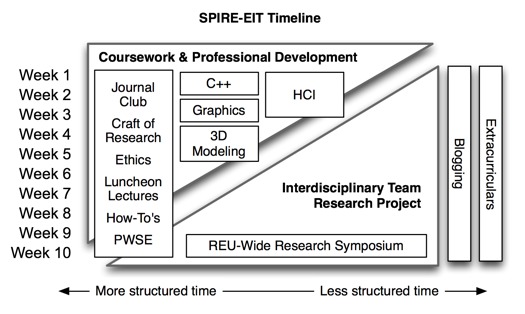
Unlike traditional summer internships, SPIRE-HCI integrates research with a structured educational curriculum. This includes:
These learning experiences are directly connected to the research projects students undertake throughout the summer.
Participants are assigned to a research team consisting of three undergraduate students. Each team is led by a VRAC faculty researcher and supported by a dedicated graduate student mentor, creating a collaborative environment that provides both technical guidance and professional mentorship.
Research projects focus on human-computer interaction and related technologies, including:
Past projects have explored topics such as measuring team performance in cooperative gaming, developing user interaction methods for 3D printing workflows, and designing immersive audio experiences for navigation and learning in XR environments.
A core component of SPIRE-HCI is individualized mentoring. Through one-on-one meetings, team discussions, and professional development activities, mentors help students identify their goals, address challenges, and develop skills that support future academic and career success.
Students gain experience in:
At the conclusion of the program, participants present their work at the Iowa State University Summer Research Symposium, joining more than 100 undergraduate researchers from across campus.
Students share the results of their summer projects through:
Many SPIRE-HCI projects continue beyond the summer and contribute to conference publications, with student participants frequently recognized as co-authors.
SPIRE-HCI is designed to be both academically challenging and personally rewarding. Throughout the summer, participants take part in educational excursions, social events, and team-building activities that help foster connections among students, faculty, and mentors.
These experiences provide opportunities to explore Iowa, build lasting friendships, and become part of a vibrant research community.
We look forward to welcoming you to the program and seeing what you’ll discover.
For questions or additional information, please contact:
SPIRE-EIT REU Coordinator
spire-eit@iastate.edu
515-294-3092
Eligibility:
Students selected to participate in the program will receive housing, a meal plan, and a stipend for the summer. The program will also contribute to their travel.
Notifications of acceptance begins (April)
Declined applicants notified by (TBD)
Overview of the 2024 SPIRE-EIT REU program
The study of the relationship between humans and increasingly powerful, portable, interconnected and ubiquitous computers has become one of the most rapidly growing and significant fields of technical investigation. Interdisciplinary in the extreme, this emerging field will have an impact on nearly every area of human endeavor. There exists a need to specifically train students in this burgeoning area, and we hold a strong commitment to train students to be the best and the brightest. We feel that involving students in cutting-edge research is the best way to prepare future engineers, scientists, and artists to work at the ever more present interface between humans and computers.
The program is a ten-week undergraduate internship where students work collaboratively in interdisciplinary teams, receive core training, and gain hands-on research experience with emerging interface technologies. Interns accepted into this program receive on-campus housing and a meal plan, as well as a stipend.

Learn how to run a successful REU program for your institution! The following site was developed from the 2017 NSF CISE REU New PI’s meeting and serves as a guide to orient and direct new REU sites.
https://www.vrac.iastate.edu/cise-reu-pi-resources